Richmond Aqueduct

Second Largest Aqueduct Built on the Enlarged Erie Canal (1856-1917)
Monday, February 21, 2011
DESIGN COMMITTEE MEETING INVITATION


Sunday, February 13, 2011
FINAL ESF PRESENTATIONS - A LOOK AT WHAT'S POSSIBLE
 |
| Lauren Christler's focus points to an area off of Chapman Avenue with linkage from past to present. |
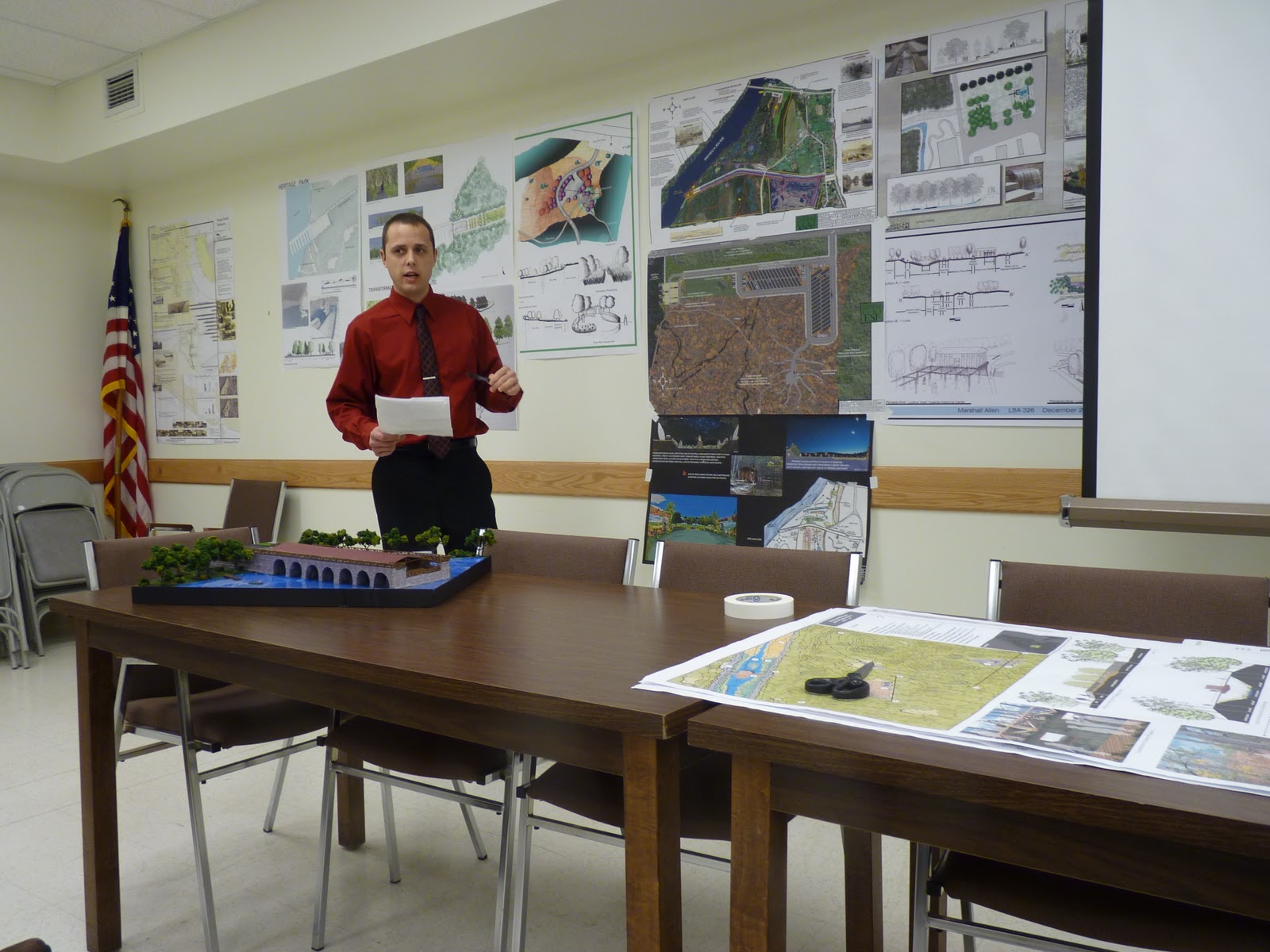
Most of the designs were focused ideas that linked our community's past Erie Canal history to the present. Using natural elements of water, plantings and organic contoured paths throughout the park, their designs showcased our history using the remains of historic sites such as the aqueduct and paper mill. This could be created through time lines flowing from the center of our town along the canal towpath to the park along the Seneca River. Monuments, statues, and an aqueduct sculpture featured throughout the site could tell the story of how the canal was built. Several recreational activities would provide for fishing, cross country skiing, walking, hiking, picnicking, primitive camping sites, boat dockage, bird and wildlife observation. Opportunities were seen for Erie Canal and natural resource education using open buildings that could later be enclosed.


 |
| Kyle Weissenburger focused on a Route 31 entrance with a nearby boat launch marketing to New York State Fishing Clubs. |
 |
| Maren King of SUNY ESF faculty member discusses student ideas with Town Supervisor John Malenick; Stan Longyear and Paul Baker, Design Committee members; Bill Hecht; and Karl Beard from the RTCA program at the National Park Service. |
Monday, January 31, 2011
MEETING ANNOUNCEMENT - SUNY ESF PARK DESIGN PROJECT
Thursday, January 6, 2011
Historic sites added to Parkland
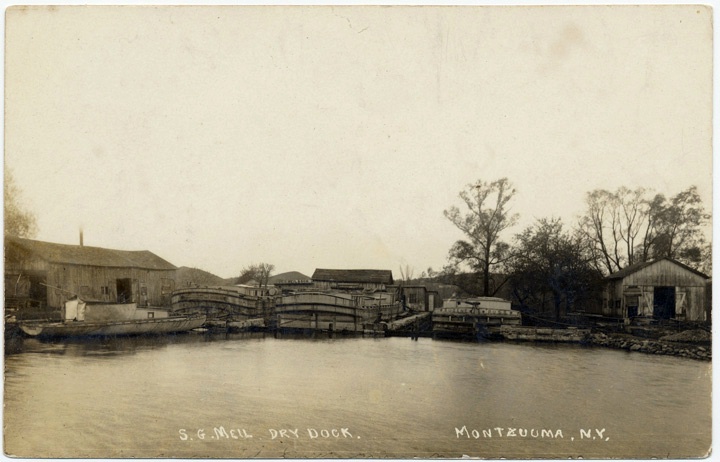
Cayuga County transferred a 23-acre parcel of land west of the former Cayuga-Seneca Canal and along the south side of the former Erie Canal. The parcel is the site of the former Meil's Drydock which was first started by William Thorn and Joshua Martin in 1860. The drydock provided a valuable service to canal business where boats were built, refurbished and repaired. The buildings in the background of the photograph above would have provided the necessary space for a blacksmith to fashion the metal parts, bolts and nails; a saw mill to cut beams and planks, and for offices and storehouses. Later in 1894 the business was purchased by George Meil of Veronia, NY. Fifteen men were employed to repair boats, build steamers and flag boats for use in the harvest of flag (cattails) in the swamps.

This important site is near where the Cayuga section of the Cayuga-Seneca Canal opened in 1828 connecting with the Erie Canal. A crossover bridge allowed the mules and crews to move from the path along the Erie Canal to the Cayuga Canal. This was an important junction where boats headed either east to Albany or west to Buffalo as well as south to Cayuga and Seneca Lakes.
Monday, December 20, 2010
Trail Blazing!
Wednesday, November 10, 2010
SUNY ESF Student Presentations - Nov 1


On Monday, November 1, 2010, the community listened as third year design studio students from SUNY - ESF Department of Landscape Architecture displayed graphic representations of their projects and described the results of their analysis and findings of the proposed park site. Through their analysis, the students have identified potential opportunities related to the Heritage Park. They highlighted the regional aspects of the site, history, wildlife and nature interpretation, commercial, recreation and performance such as music, plays, interpretative events and festivals. The students did an excellent job of researching the site and analyzing the potential for the park. There was good feedback and discussion from the audience for the students to consider as they now move on to their final design concepts for the park.

Monday, October 25, 2010
ESF Students to Present Park Designs on November 1
The public is invited to welcome landscape architecture students from the State University of New York College of Environmental Science and Forestry on Monday evening, November 1, 2010 at 6:30 PM at the Montezuma Town Hall. The students will share their visions for the proposed development of 140 acres of town-owned parkland with historic and natural resources in the Town of Montezuma.
On October 1, 2010, forty-three ESF students and college staff made a preliminary visit to tour the park site followed by a meeting with design committee members at the town hall for the purpose of developing design ideas for the Heritage Park. The design process was initiated by Supervisor John Malenick, a graduate of the ESF collage. He contacted ESF's Center for Community Design Research to request design assistance from landscape architecture faculty and students to help prepare design studies. He realized that the time had come to look at the potential the parkland held economically and recreational for the community.
It was important to the supervisor that community members be involved in the park design process from the very early stages, and he requested in February 2010 the town board appoint a design committee and encouraged interested residents to become involved. The primary goal for the design committee working with the students was to look for ways to approach the park development based on an understanding of community values and needs, as well as an analysis of park site conditions and Erie Canal history to use as the basis of dialogue with the broader community. Academically, the primary goals were to provide an opportunity for design students to learn and practice skills of engaging community members in the design process, to understand the important roles that community members have in creating place-appropriate designs, and to apply emerging design and graphic skills on a project that would benefit our community.
It is anticipated that the collaboration between the landscape architecture students and the Town of Montezuma community will produce a series of useful outcomes, including site analysis and inventory, preliminary lists of activities and program, and alternative design ideas around which to base in-depth design proposals. Most importantly, it is the intent of the Design Committee that this will begin the process of additional involvement within the community members and encourage dialogue and participation to encourage development and pride in the community.
Come and see what the students have designed. Community members will have an opportunity to offer suggestions on their designs ideas and the students will return with the final project in a few weeks. This is the beginning of a community dialogue to have input on the development of the park.